Many districts have made meaningful progress in early literacy.
Through focused investment in early childhood programs, science-of-reading-aligned instruction, and targeted interventions, more students are reaching proficiency in the early grades than ever before.
But there’s a persistent—and frustrating—reality:
Those gains don’t always last.
The Pattern District Leaders Know Too Well
Students who read well in kindergarten through third grade often begin to:
- Plateau in upper elementary
- Lose motivation and engagement
- Struggle to apply literacy skills in more complex contexts
This is not a failure of early instruction.
It’s a breakdown in what comes next.
Why Early Literacy Gains Fade Over Time
In many districts, early literacy is treated as a milestone:
- A phase to complete
- A benchmark to reach
- A short-term initiative to fund and implement
Once students are “reading,” the system shifts focus.
But literacy is not a static skill—it’s developmental.
As students move through grades, the demands change dramatically:
- Texts become more complex
- Vocabulary becomes more abstract
- Comprehension requires background knowledge and critical thinking
- Application extends into content areas and real-world contexts
When instruction and support don’t evolve alongside these demands, early gains begin to erode.
The Core Issue: A Lack of System Coherence
What’s often missing isn’t effort—it’s continuity.
Across a typical district system:
- Early childhood programs operate separately from K–5 instruction
- Elementary literacy focuses on foundational skills
- Middle school shifts toward content and subject-area literacy
- Family engagement declines as students get older
These pieces may each be strong individually—but without alignment, they don’t function as a cohesive system.
The result:
Students experience literacy as disconnected stages instead of a continuous progression.
What Sustained Literacy Success Actually Requires
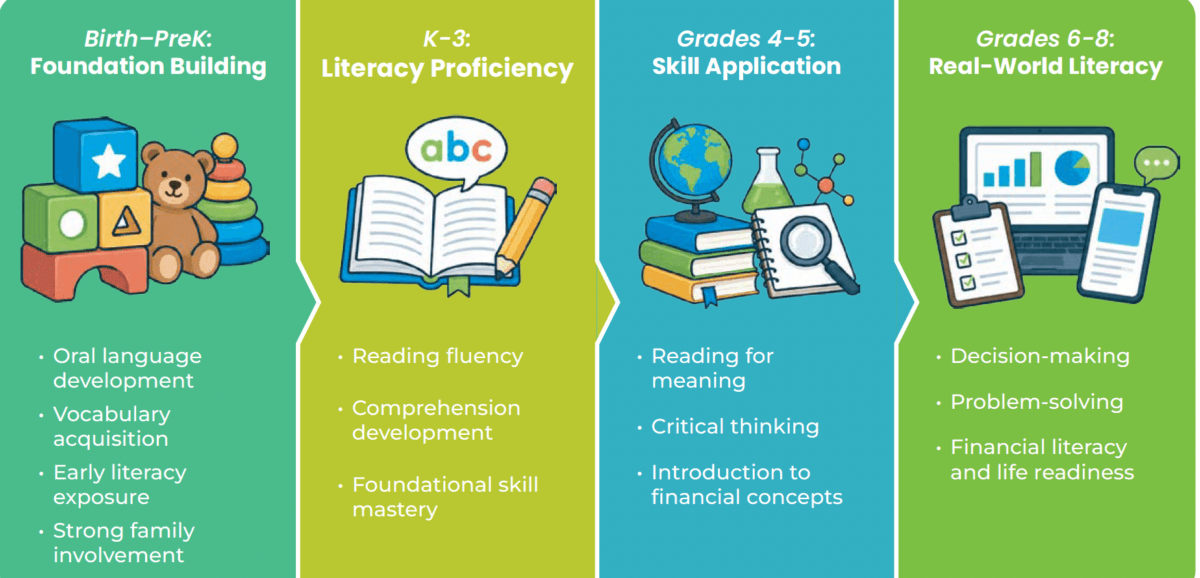
To move from short-term improvement to long-term impact, districts must design for continuity across the Birth–8 continuum.
That means ensuring:
- Instructional Alignment Across Grades
Skills are intentionally built year over year—not repeated, not skipped, but deepened. - Ongoing Reinforcement Beyond the Classroom
Students need consistent opportunities to practice and apply literacy skills in meaningful ways—especially outside of school hours. - Real-World Application
Literacy must extend beyond reading texts to interpreting information, making decisions, and solving problems. - Continued Family Engagement
Family involvement cannot stop after early grades. It must evolve alongside the learner—supporting independence while maintaining connection.
The Missing Link: Application and Relevance
One of the biggest reasons students disengage is simple:
They don’t see the relevance.
By upper elementary and middle school, literacy must connect to real life:
- Understanding information
- Making informed decisions
- Navigating everyday situations
This is where life skills—especially financial literacy—become essential extensions of literacy development.
When students apply reading, writing, and thinking skills to:
- Earning and saving
- Budgeting and spending
- Evaluating choices and consequences
…literacy becomes purposeful.
And when learning feels purposeful, engagement follows.
Why a Birth–8th Grade System Changes the Outcome
Sustaining literacy gains requires more than programs—it requires infrastructure.
A coherent Birth–8 system ensures that:
- Early gains are not isolated—they are reinforced
- Skills continue to build in complexity and relevance
- Learning extends beyond the classroom into the home and community
- Families remain active partners throughout a child’s development
This is where Footsteps2Brilliance plays a critical role.
Rather than treating early literacy, family engagement, and life skills as separate initiatives, it connects them into a unified system that:
- Supports language and literacy development from birth
- Provides ongoing, aligned learning experiences through elementary and middle school
- Engages families with simple, actionable ways to reinforce learning daily
- Integrates financial literacy and real-world application to sustain engagement
The result is not just early success—but sustained growth.
From Short-Term Wins to Long-Term Impact
When districts shift from isolated efforts to a continuous literacy system, the outcomes change:
- Early literacy gains are maintained and extended
- Students remain engaged as learning becomes more relevant
- Families stay connected as partners in learning
- Gaps narrow over time instead of re-emerging
Most importantly, students don’t just learn to read.
They use literacy as a tool to navigate their world.
The Strategic Shift Ahead
The question for district leaders is no longer:
“How do we improve early literacy?”
It’s:
“How do we sustain it?”
Because true literacy success isn’t defined by third-grade proficiency.
It’s defined by whether students continue to grow, apply, and thrive long after.