
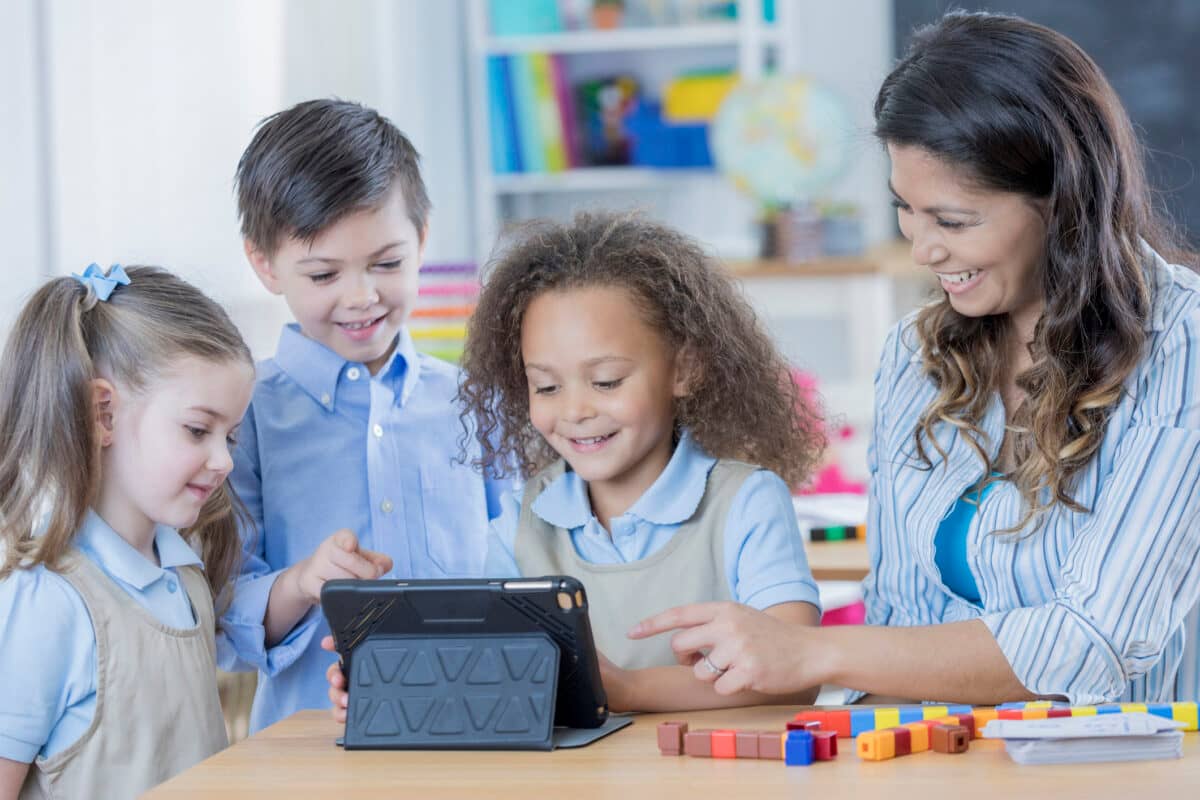
District leaders, educators, and families are asking the right question:
How much screen time is too much?
But that question often misses a more important one:
What kind of screen time are students experiencing?
Not all screen time is created equal.
Passive consumption—scrolling, tapping, or watching without interaction—does little to build language, literacy, or critical thinking. In fact, it can replace the very experiences children need most: conversation, exploration, and real-world application.
But when technology is designed intentionally, it can do something very different.
It can spark learning that extends far beyond the screen.
A Shift from Consumption to Activation
The most effective digital learning tools don’t try to replace real-world experiences.
They ignite them.
High-quality digital learning should:
- Build vocabulary and background knowledge through rich, meaningful content
- Prompt thinking, questioning, and interaction
- Encourage learners to apply what they’ve learned in their daily lives
This is where many solutions fall short—they stop at engagement.
But engagement alone doesn’t drive outcomes.
Application does.
How Footsteps2Brilliance Redefines Digital Learning
Footsteps2Brilliance was built on a fundamentally different belief:
Technology should be the starting point of learning—not the endpoint.
Instead of keeping children on screens, the platform is intentionally designed to move them off screens and into real-life experiences.
- Digital Experiences Spark Learning
Students engage with interactive stories, songs, and activities that build:
- Oral language
- Vocabulary
- Comprehension
- Background knowledge
These aren’t isolated skills—they are the foundation of literacy and lifelong learning. The skills are aligned to the district’s core curriculum and can be used to pre-teach or provide deliberate practice to students after instruction.
But the goal isn’t just exposure.
It’s activation.
- Offline Activities Reinforce It
Every digital experience is paired with simple, accessible offline activities that families and caregivers can do together.
These activities:
- Reinforce key concepts from the digital experience
- Encourage conversation and language development
- Require little to no materials
- Are designed for real families in real environments
This is critical—because learning doesn’t happen in isolation.
It happens through interaction.
- Real-World Application Makes It Stick
The final—and most important—step is application.
Students don’t just read about concepts—they use them:
- Practicing language in conversations
- Applying comprehension in everyday situations
- Making decisions that connect to real-life scenarios
In the case of older students, this extends into financial literacy and life readiness, where learners move from understanding concepts to applying them in meaningful ways.
Because when students apply what they learn,
learning becomes permanent.
Why This Matters for Districts
Districts today face a dual challenge:
- Improve literacy outcomes
- Ensure learning transfers beyond the classroom
This requires more than curriculum.
It requires a system that connects:
- School and home
- Digital and real-world experiences
- Academic learning and life application
Footsteps2Brilliance addresses this by:
- Extending learning into the home through family engagement
- Providing continuity from early childhood through middle school
- Ensuring that digital learning drives real-world outcomes—not just screen time
From Screen to Life: What Real Learning Looks Like
When technology is used the right way, the results look different:
Instead of:
- Students passively consuming content
You see:
- Students talking, questioning, and applying
Instead of:
- Learning ending when the device turns off
You see:
- Learning continuing in conversations, activities, and decisions
Instead of:
- Families disconnected from instruction
You see:
- Families actively participating in their child’s learning journey
The Bottom Line
The conversation shouldn’t be about reducing screen time alone.
It should be about transforming it.
Because when digital learning is designed to:
- Spark curiosity
- Extend beyond the device
- Drive real-world application
…it becomes one of the most powerful tools we have.
Footsteps2Brilliance doesn’t just use technology.
It uses technology to create learners who think, apply, and thrive—far beyond the screen.