For students with disabilities, literacy is more than an academic skill. It is a gateway to communication, independence, confidence, participation, and future opportunity.
Yet supporting struggling readers and students with disabilities requires more than simply giving them additional practice. Students need instruction that is evidence-based, accessible, flexible, engaging, appropriately scaffolded, and responsive to their individual progress.
That is increasingly reflected in federal education priorities as well.
In 2026, the U.S. Department of Education made evidence-based literacy a central priority across grantmaking, research, and technical assistance. The Department also created a National Comprehensive Center focused specifically on improving literacy for students with disabilities, including students with dyslexia, developmental delays, and disabilities affecting reading, writing, language processing, comprehension, and executive functioning.
For schools and districts, the message is increasingly clear:
Students with disabilities need access to high-quality literacy instruction—and they need the right supports to successfully participate in it.
At Footsteps2Brilliance, that philosophy is embedded into the way our literacy ecosystem is designed.
Start With the Expectation That Every Child Can Learn
One of the most important principles in special education is beginning with high expectations.
Federal guidance on inclusive educational practices emphasizes that students with disabilities should have meaningful opportunities to participate, engage, learn alongside their peers, and make progress in the general education curriculum. It also emphasizes accessible and flexible learning environments, differentiated instruction, individualized accommodations, evidence-based MTSS practices, family partnership, and appropriately prepared educators.
Footsteps2Brilliance begins from a similar premise: give every learner access to rich, meaningful literacy experiences and then provide multiple pathways for that learner to succeed.
Our approach is particularly well suited to students who may need additional support because it combines comprehensive literacy instruction with multimodal learning, immediate feedback, repetition, opportunities to build automaticity, and ongoing formative assessment.
Rather than lowering expectations, the goal is to remove unnecessary barriers to learning.
-
Making Literacy Instruction More Accessible
Students do not all access information in the same way.
For some learners, listening to a story while seeing the words highlighted can strengthen understanding. Another student may benefit from music, manipulatives, games, repeated practice, visual cues, or opportunities to interact with text.
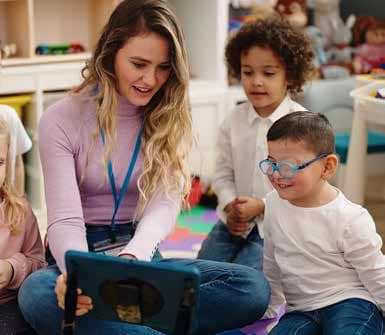
Footsteps2Brilliance provides a multimodal learning environment that includes direct instruction, music, nursery rhymes, literature, informational and STEM texts, digital manipulatives, games, exploration, projects, and writing experiences.
This matters because accessibility should not be something schools add after a student struggles. Whenever possible, accessibility should be part of the learning environment from the beginning.
That philosophy is closely aligned with current federal guidance encouraging accessible, inclusive, and flexible instructional environments that allow students with disabilities to participate meaningfully in learning.
-
Providing the Repetition Some Learners Need—Without Stigma
Learning rarely happens on the same timetable for every student.
Students with disabilities may need more opportunities to hear a word, practice a phonics pattern, reread a story, manipulate sounds, respond to questions, or revisit a skill before it becomes automatic.
In a traditional classroom, providing that degree of repetition can be difficult. Students may also become reluctant to repeatedly ask an adult for help.
Technology can create another pathway.
Within Footsteps2Brilliance, students have repeated opportunities to practice activities while receiving immediate feedback, hints, and scaffolding. Students can make multiple attempts and revisit activities they have already experienced.
Repetition becomes part of learning—not evidence of failure.
That distinction can be especially important for students who have experienced repeated frustration with reading.
-
Building Early Success Before Students Begin to See Themselves as “Struggling Readers”
Intervention matters. But timing matters too.
IDEA Part C specifically recognizes the importance of early intervention services for infants and toddlers with disabilities and their families, while IDEA Part B protects students’ access to a free appropriate public education as they enter the school system. The Department’s most recent annual IDEA reporting continues to focus on both early intervention and improved educational outcomes for children with disabilities.
Footsteps2Brilliance extends literacy learning all the way into the earliest years.
This creates an important opportunity for communities: rather than waiting until children enter elementary school and demonstrate significant reading difficulty, families and early childhood educators can begin building language, vocabulary, phonological awareness, early literacy behaviors, and a love of books much earlier.
Our special education white paper describes how students can experience early success with developmentally appropriate material that provides support when needed while still giving children opportunities for independence and choice.
For children who require additional time or repetition, those early experiences can be especially powerful.
The earlier we strengthen the foundation, the less likely we are to spend years trying to repair it.
-
Using Data to Move From “More Intervention” to the Right Intervention
Special educators know that intervention cannot simply mean giving a student more of the same instruction.
Teachers need to understand:
- What does the student already know?
- Where is the breakdown occurring?
- Which skills are developing?
- Where is additional instruction needed?
- Is the intervention working?
Current IDEA accountability continues to focus not only on procedural compliance but also on results for children and families. State Performance Plans and Annual Performance Reports measure both IDEA implementation and child and family outcomes, and the Department uses those results in its annual determinations of state performance.
Footsteps2Brilliance helps educators make learning visible.
As students engage in literacy activities, the platform monitors foundational literacy skills and provides teachers with information about student strengths and weaknesses. Educators can use this information to differentiate learning, target intervention, and monitor progress.
That creates an important shift.
Instead of asking: “Did the student complete the intervention?”
educators can ask: “Is the student learning?”
That is the question that ultimately matters.
-
Supporting an MTSS Approach Without Creating a Separate Literacy Experience
One of the most encouraging directions in special education is greater coordination between general education and special education rather than treating them as completely separate systems.
Federal guidance specifically identifies high-quality, evidence-based Multi-Tiered Systems of Supports (MTSS) as one component of inclusive educational practice. It also encourages stronger coordination among general educators, special educators, school leaders, and families.
Footsteps2Brilliance can support that kind of continuum and bring a cohesive literacy experience between the core literacy program and intervention.
Students can access rich literacy content as part of core instruction while teachers use additional practice, targeted assignments, repetition, scaffolding, and progress data to support learners who need greater intensity.
This means a student receiving additional support does not have to be disconnected from the literacy experiences of classmates.
The intensity of support can change.
The expectation that the child can become a successful reader does not.
-
Strengthening the Connection Between School and Home
Families are not peripheral to special education. They are essential partners.
Federal inclusive-practices guidance describes families as collaborative partners, experts, and engaged decision-makers in students’ lives.
That belief is central to Footsteps2Brilliance as well.
Because literacy experiences can extend beyond the classroom, families can participate in learning rather than simply receiving reports about learning.
Books, literacy activities, games, and learning experiences can become part of daily routines at home. The program also includes parent resources and activity guides designed to help families reinforce learning.
For a student receiving special education services, this school-to-home connection can provide something especially valuable: more opportunities to practice important skills in a familiar, supportive environment.
And rather than asking families to become reading specialists, we can give them practical ways to reinforce what their child is already learning.
-
Helping Teachers Differentiate Without Asking Them to Build Everything From Scratch
Inclusive education depends on excellent educators. It also places enormous demands on them.
A single classroom may include students reading above grade level, students receiving Tier 2 or Tier 3 intervention, students with IEPs, multilingual learners, students with language delays, and children whose literacy development has been interrupted.
Differentiation cannot mean asking teachers to individually build an entirely different curriculum for every learner.
Footsteps2Brilliance gives teachers a broad collection of standards-aligned literacy resources, interactive books, games, writing activities, printable materials, lesson plans, formative information, and instructional tools that can help educators respond to different learning needs.
The technology does not replace the teacher. It gives the teacher more ways to reach the learner.
Literacy Belongs at the Center of the Special Education Conversation
The federal focus on literacy for students with disabilities is significant.
In 2026, the Department of Education specifically established a national center charged with identifying and disseminating evidence-based literacy assessments, instructional strategies, accommodations, and professional-development resources for students at risk of not achieving full literacy because of a disability.
At the same time, the Department has identified literacy as a broader national priority and is investing in evidence-based approaches to strengthening reading outcomes.
These priorities reinforce something educators have understood for years:
Special education students do not need a lesser version of literacy instruction. They need excellent literacy instruction delivered with the accessibility, differentiation, intensity, repetition, scaffolding, and support necessary for them to succeed.
That is where Footsteps2Brilliance can help.
From Access to Achievement
True inclusion is not simply putting students in the same room or giving them access to the same program.
It means creating the conditions that allow them to participate, grow, achieve, and belong.
For students with disabilities, those conditions may include:
- Multiple ways to access and engage with content
- Explicit and developmentally appropriate literacy instruction
- Immediate feedback and scaffolding
- Repeated opportunities to practice
- Targeted intervention informed by data
- Progress monitoring
- Strong connections between school and home
- Resources that help educators differentiate instruction
- The expectation that every learner is capable of meaningful growth
Footsteps2Brilliance was designed around many of these very principles.
Because when we create literacy environments that respond to how children actually learn, we do more than accommodate differences.
We expand the opportunity for every child to become a confident, capable reader.
Want to explore how Footsteps2Brilliance can support your district’s special education, MTSS, and literacy priorities?
Let’s start with your students and your goals. Learn how Footsteps2Brilliance can become part of a connected literacy system that supports learners from early childhood through elementary school—at school, at home, and across the community. Contact us at support@footsteps2brilliance.com.