
Financial Literacy Pilot (Spring 2025)
Project Overview
In Spring 2025, Footsteps2Brilliance conducted a financial literacy pilot program in partnership with Riverside County Office of Education. Ten classrooms representing grades 4 and 5 participated. The students read a series of high-interest books and completed interactive activities to build both ELA and financial literacy skills.
Teachers implemented the program by assigning up to 12 book lessons for students to complete independently supported by classroom lesson plans and discussion prompts. Students completed five core activities per book lesson: reading, vocabulary games, comprehension questions, financial literacy practice, and writing to a prompt with AI-driven feedback and scoring.
To evaluate the impact of the program, students were given a 15-question pre- and post-assessment aligned to the financial literacy standards and curriculum content. This report analyzes those assessment results, focusing on how student understanding changed from the beginning to the end of the program.
Assessment Results and Interpretation
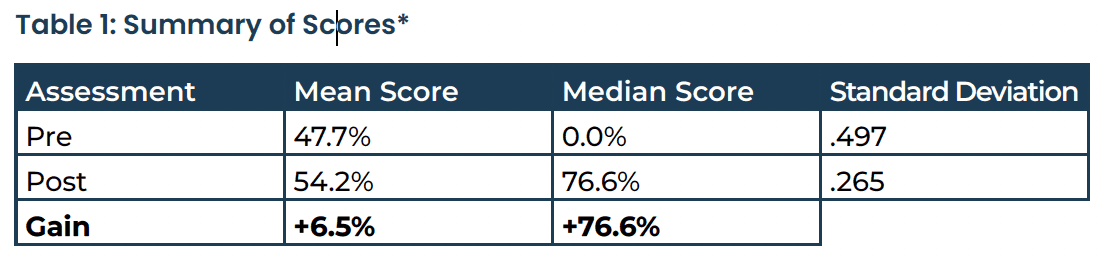
To measure student learning, we analyzed results from the 15-question pre-and post-assessment, focusing exclusively on answered questions. Below is a summary of key descriptive statistics:

Key Findings
1. The Curriculum Produced Widespread Learning Gains
The median assessment score increased from 0.0% to 76.6%, indicating that most students moved from minimal prior knowledge to strong performance. This reflects the curriculum’s ability to reach a broad range of learners effectively.
2. Instruction Had the Greatest Impact on High-Value Financial Literacy Understanding
The greatest learning gains occurred in real-world financial concepts like opportunity cost (+41.6%), emergency savings (+34.2%), and credit and borrowing (+28.7%)—skills that are foundational to responsible financial decision-making.
3. Students Entered the Program With Limited Background Knowledge
At the start, at least half of the students scored zero, despite answering questions. This confirms that the pilot reached students who had limited exposure to financial literacy concepts or vocabulary prior to instruction.
4. Posttest Results Show More Consistent Mastery Across the Group
After instruction, not only did scores improve, but the spread of scores narrowed (standard deviation dropped from 0.497 to 0.265), suggesting the program helped bring all students to a more consistent level of understanding.
5. The Curriculum Closes Learning Gaps
While the average score increase was modest (+6.5%), the large median gain (+76.6%) demonstrates that students who began with little to no knowledge made significant strides—indicating strong support for learners at all levels.
Summary
These findings demonstrate that the financial literacy curriculum— delivered through integrated reading, writing, vocabulary, and game-based experiences—had a measurable and meaningful impact on student learning. In particular, students showed the greatest growth in foundational topics such as opportunity cost, saving for emergencies, and responsible borrowing.
The curriculum not only raised overall performance, but also closed the gap between lower- and higher-performing students, making it a promising Tier 1 resource for building essential life skills across diverse classrooms. The alignment to both academic and financial literacy standards ensures that students are not only learning how to read but also how to make smart money decisions that will benefit them for life.